
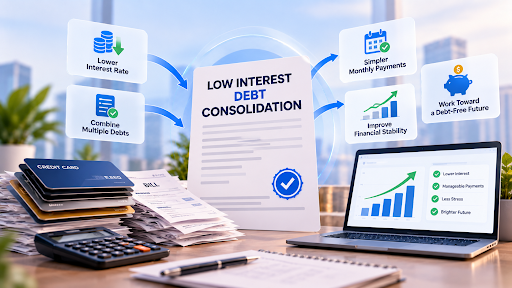
Juggling several bills each month wears people down. Low-interest debt consolidation turns those balances into one payment with a lower rate. As a result, you can save money and see a clear payoff date.
Debt is also extremely common. In fact, the average American carries a significant amount of debt, and credit cards make up a large share. Therefore, many households search for ways to cut their interest costs.
This guide explains how low-interest debt consolidation works and who qualifies. Moreover, it shows you how to compare lenders, avoid fees, and spot red flags.
What Is Low-Interest Debt Consolidation?
Low-interest debt consolidation means combining several debts into one new loan with a lower rate than you pay now. You use the new funds to clear your old balances. After that, you repay a single lender.
Most people use a personal loan for this. Others choose a balance transfer card or a home equity loan. However, each option carries different costs and risks, so comparison matters.
Consolidation does not erase what you owe. Instead, it changes how you repay it. You save money only when the new loan has a lower rate, a shorter term, or both.
How Low-Interest Debt Consolidation Works
The process follows a simple path. Here is what usually happens:
- You apply for a new loan and state how much you need.
- The lender reviews your credit, income, and existing debts.
- If approved, the lender sends money to your creditors or to you.
- You pay off the old accounts in full.
- You make one fixed payment on the new loan each month.
Some lenders pay your creditors directly. Others deposit the money into your bank account. In the second case, you must pay off the old debts yourself right away.
Fixed rates are common on these loans. Consequently, your payment stays the same until you finish repaying. That predictability makes budgeting much easier.
Benefits of Low Interest Debt Consolidation
A lower rate is the main draw. Still, the advantages go further. Consider these common benefits:
- Lower interest costs: You pay less to borrow the same amount.
- One monthly payment: You track a single due date instead of many.
- Faster payoff: Lower interest means more of each payment reduces your balance.
- Clear timeline: A fixed term gives you an exact finish line.
- Less stress: Fewer accounts mean fewer chances to miss a payment.
However, low-interest debt consolidation is not a cure-all. It works best when you pair it with a budget. Otherwise, old habits can bring new balances.
Who Qualifies for Low-Interest Debt Consolidation?
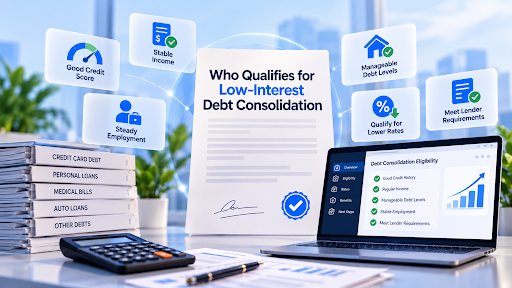
Lenders reserve their best rates for strong borrowers. They look at several factors:
- Credit score: Higher scores usually earn lower rates.
- Income: Steady earnings show you can repay the loan.
- Debt-to-income ratio: A lower ratio signals less risk.
- Credit history: A record of on-time payments helps.
Don't panic if your score is average. Some lenders approve fair-credit borrowers, although they charge higher rates. In addition, a co-signer with strong credit can improve your offer.
Always check whether the new rate beats your current average rate. If it does not, consolidation may cost you more.
Where to Find Low Interest Debt Consolidation Loans
Several lender types offer low-interest debt consolidation loans. Each has strengths.
Credit unions. According to the National Credit Union Administration, credit unions typically charge lower average loan rates than banks. They operate as not-for-profit institutions, which helps explain the difference. Membership rules apply, but many are easy to meet.
Banks. Large banks often reward existing customers with rate discounts. Therefore, check your own bank first. Approval standards can be stricter, though.
Online lenders. These companies offer fast applications and quick funding. Some also look beyond credit scores and review factors such as income and job history. However, you should confirm the lender is reputable and clear about fees.
Low-interest debt consolidation loans from any of these sources deserve a side-by-side comparison. Never accept the first offer you see.
How to Find the Best Offer, Step by Step
A careful search can save you thousands of dollars. Follow this process:
- List every debt. Write down each balance, rate, and minimum payment.
- Check your credit. Review your reports and fix any errors first.
- Set a target. Decide your ideal monthly payment and payoff date.
- Prequalify with several lenders. Use soft credit checks, which do not hurt your score.
- Compare APRs. The annual percentage rate includes fees, so it shows the true cost.
- Read the fine print. Look for penalties and hidden charges.
- Apply with your best choice. Submit documents and wait for approval.
Prequalifying is a key habit. It lets you see real rates without a hard inquiry. As a result, you can shop widely at no cost to your credit.
Watch for Fees and Fine Print
A low advertised rate does not guarantee savings. Fees can quietly raise your total cost. Therefore, always review these items:
- Origination fees: Many lenders charge a percentage of the loan, often taken from your funds.
- Late payment fees: Missed due dates can add penalties.
- Prepayment penalties: Some lenders charge you for paying early, though many do not.
Focus on APR instead of the interest rate alone. APR combines interest and fees into one number. Consequently, it makes lender comparisons fairer.
Loan length matters too. A longer term lowers your payment, but it raises total interest. Choose the shortest term you can comfortably afford.
A Simple Example of Potential Savings
Numbers make this concrete. Here is how low-interest debt consolidation can save money. Imagine you owe $15,000 on credit cards at 24% APR. You plan to repay it over 36 months.
At 24%, your payment would be about $589 a month. You would pay roughly $6,186 in interest. Now imagine you consolidate into a 12% APR loan for the same 36 months.
Your payment drops to about $498 a month. Total interest falls to roughly $2,935. In this example, you save about $3,250 and cut your monthly bill by around $90.
These figures are illustrative. Your rate, fees, and term will differ. Even so, the example shows why a lower rate matters so much.
How Low-Interest Debt Consolidation Affects Your Credit
Many borrowers worry about their score. The impact is usually short-term and manageable. Here is what to expect:
- A hard inquiry: Applying can cause a small, temporary dip.
- A new account: This lowers your average account age slightly.
- Lower card utilization: Paying off cards often boosts your score.
- On-time payments: Consistent payments build strong credit over time.
Low-interest debt consolidation can help your score when you keep up with payments. However, running up your cards again can undo the progress.
Other relief options affect credit differently. For a closer look, read how debt relief affects your credit score . That comparison helps you weigh consolidation against more aggressive solutions.
Risks and Common Mistakes to Avoid
Consolidation can backfire when borrowers rush. Watch for these mistakes:
- Choosing the longest term without checking total interest.
- Ignoring origination and other fees.
- Using paid-off credit cards for new spending.
- Skipping a budget or repayment plan.
- Borrowing more than you need.
Low-interest debt consolidation fails when spending habits stay the same. Therefore, build a budget before you apply. Then freeze or limit card use while you repay.
Be careful with scams, too. Warning signs include:
- Guaranteed approval with no credit review.
- Requests for upfront fees.
- Unusual payment methods, such as gift cards or cryptocurrency.
- Pressure to sign immediately.
Legitimate lenders explain their terms clearly. If something feels off, walk away.
Alternatives to Low Interest Debt Consolidation
Consolidation does not suit everyone. If you cannot qualify for a good rate, consider other paths:
- Balance transfer cards: Some offer a 0% introductory rate. However, the rate rises after the promotional period, and transfer fees apply.
- Debt management plans: A credit counsellor negotiates lower rates with your creditors.
- Debt snowball or avalanche: You pay off balances in a chosen order without a new loan.
- Debt settlement: A company negotiates to reduce what you owe, though it can hurt your credit.
Business owners face their own challenges. If company debt is the problem, explore business debt settlement as a possible route. It works differently from personal consolidation, so review the details carefully.
Final Thoughts
Low-interest debt consolidation can simplify your finances and cut what you pay in interest. However, the savings depend on the details. Compare lenders, review the APR, and understand every fee before you sign.
In addition, pair your new loan with a realistic budget. That step keeps you from sliding back into debt. Ultimately, low-interest debt consolidation works best as one part of a bigger plan to take control of your money.
Frequently Asked Questions
1. What is low interest debt consolidation?
Low-interest debt consolidation combines multiple debts into one loan with a lower rate. You use the new loan to pay off old balances. Then you make a single monthly payment.
2. Is low-interest debt consolidation worth it?
It is worth it when the new APR is lower than your current average rate. Fees and loan length also matter. Compare the total cost, not just the monthly payment.
3. Can I get low interest debt consolidation with bad credit?
You can still find loans, but rates will be higher. A co-signer, a secured loan, or a credit union may improve your odds. Meanwhile, building your score first can unlock better offers.
4. Does debt consolidation hurt my credit score?
You may see a small, short-term drop from the hard inquiry and new account. Over time, on-time payments and lower card balances often help your score.
5. How long does it take to get a consolidation loan?
Online lenders can approve and fund loans within a few days. Banks and credit unions may take longer. Having your income documents ready speeds up the process.
6. Does consolidation reduce the amount I owe?
No. It only changes the rate, term, and payment structure. You still repay the full balance plus interest.